May 5, 2026
Purpose of the Study
This study evaluated the effectiveness of established CT signs in detecting traumatic diaphragmatic injuries resulting from both blunt and penetrating trauma. It assessed the diagnostic accuracy of these signs—including sensitivity, specificity, and predictive value—as well as the consistency of interpretation among radiologists. By comparing patients with confirmed injuries to those without, and analyzing results by mechanism of trauma, the study identified the most reliable CT signs for diagnosis. The overall goal was to improve early detection, enabling timely treatment and reducing the risk of long-term complications from missed injuries.
How the Study Was Done
This retrospective study included consecutive trauma patients who underwent multidetector CT of the chest and abdomen within 24 hours of admission and had operative confirmation of the presence or absence of diaphragmatic injury at exploratory laparotomy over a 13-year period. Two experienced radiologists independently and blindly reviewed all CT examinations for predefined direct and indirect signs of diaphragmatic injury. Diagnostic performance metrics—including sensitivity, specificity, interobserver agreement, and mechanism-specific predictors—were calculated using intraoperative findings as the reference standard.
Key Findings
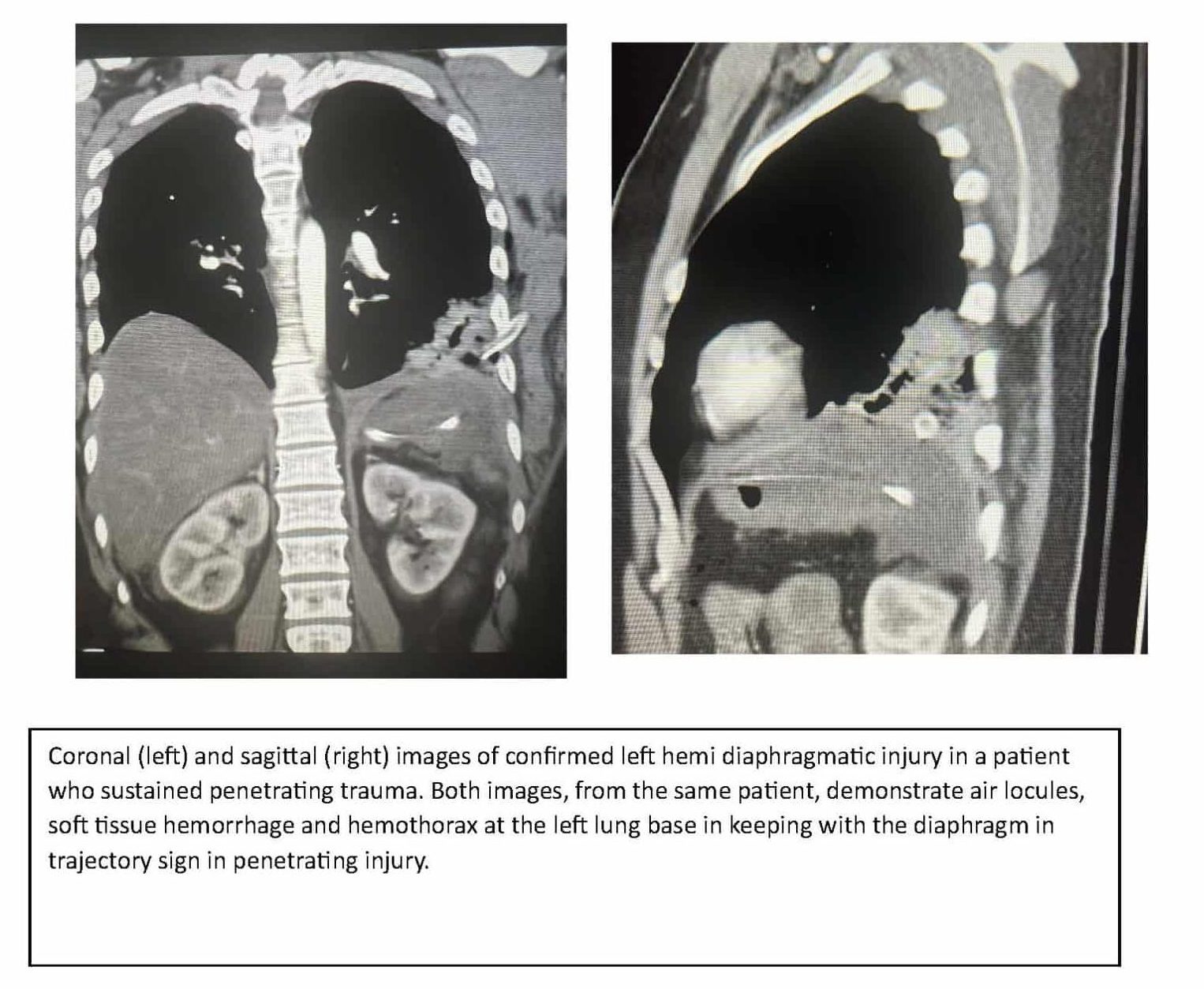
The study demonstrated strong interobserver agreement for most CT signs, with near-perfect concordance for key findings such as diaphragmatic discontinuity, intrathoracic herniation, and the dependent viscera sign in blunt trauma, as well as the trajectory sign in penetrating trauma. Diagnostic performance varied by mechanism: discontinuity and herniation were the strongest independent predictors in blunt trauma, while the trajectory sign and focal thickening were most predictive in penetrating trauma. Overall radiologist impressions showed high sensitivity across mechanisms, although both false-negative and false-positive interpretations occurred, often in the setting of complex polytrauma. Associated injuries, such as hemothorax and hemoperitoneum, were common in both groups, highlighting the importance of interpreting diaphragmatic findings within the broader context of injury patterns.
Who Performed the Study
Drs. Mahdi Saleh and Shobhit Mathur led this collaborative radiology study with the trauma surgery team at St. Michael’s Hospital. Contributing co-authors included Drs. Yigal Frank, Matias F. Callejas, Yangmei Li, David Gomez, Vinu Mathew, Asutosh Sahu, Joel Kosowan, Noah Ditkofsky, Robert Moreland, and Jessica Rotman.
Link to Publication: https://doi.org/10.1007/s10140-026-02446-6